
The Australian singer-songwriter Ruel’s newest single is a cocktail mix of regret, hope and joy.
In September 2017, Elton John played a new single – “Don’t Tell Me” – on BBC Radio 1. It wasn’t his – the British musician and two-time Golden Globe award winner praised the writer and singer of “Don’t Tell Me” as ‘having the most amazing voice I’ve ever heard from a male singer at 14 years of age’. The singer’s name was Ruel Vincent van Djik. Smooth-cheeked and serious, he performed to a sell-out crowd in Sydney, won the Breakthrough Artist award, and had a brief stint performing in opening acts of Shawn Mendes’ 2018 tour. Five years later, the British-Australian singer grew a moustache, hoisted his guitar and released “Someone Else’s Problem”, a sober breakup song tinged with relief and hope. The distinctive warbly twang of Ruel’s voice reminds me of Frank Sinatra in ‘Fly Me To The Moon’ with a dash of Conan Gray in ‘Heather’; it occupies the space between wistful and remorseful like a tired reveller choosing between gin and vodka.
About the song itself – it embraces the thematic heaviness and unapologetic lyricism of his earlier singles, unselfconsciously rewinding a failed relationship like a mixtape. Ripe with commentary, Ruel oscillates between resignation and reflection – “It’s hard to be alone/ But I know I’ll find a way to cope/ Yeah, I thought I’d be upset/ I thought I’d have regrets/ Without you in my head” – in a closed circuit. With all the cards on the table, there’s no more revelations to be had. It would be unfair to pigeonhole his latest single as merely a moody breakup song. It is a breakup song, in the most elastic sense of the word, grieving for a past lover and days gone by, but don’t expect a sober service. The mourning will be wild.
First of all, congratulations on your new single. Who or what inspired you to write this particular song?
It’s not on a particular person – I was just playing with the feeling of being really stoked someone’s out of your life – just being really happy that, y’know, you’ve moved on from someone who’s been bringing you down… we wanted to make a sing-along kind of song – it was super fun to write. It just feels very feel-good. I haven’t written any feel-good songs lately.
Writing songs, or creating anything – basically putting yourself out there – is a process that requires vulnerability, especially regarding the subject matter of breakups. How do you muster the courage to do so?
I think once you put your feelings and experiences into a song, that makes it a lot easier to cope – it’s kind of like therapy, in a way that you can see it from a different perspective. And when you put it out, it doesn’t feel like laying all your emotions and experiences onto strangers, it feels like you’re just portraying a feeling. And that’s what excites me about songwriting, because that’s the constant goal, trying to convey all these new feelings and experiences that I’m having, and put it in a way that people haven’t heard before, make them feel the most of any type of emotion.
You mentioned that your songs have been quite sad recently. I noticed you started off with a distinctly sadder note in “Let the Grass Grow”, but then the next two songs, ‘You Against Yourself’ and ‘Someone Else’s Problem’ were more focused on self-improvement and growth. What changed?
I don’t know. I actually wrote a lot more sad songs after “You Against Yourself”. In COVID I was really existential in “Let the Grass Grow” – this feeling of everything that’s wrong with the world and how I’m just a part of the problem – that’s why I was so dark. Feeling like a speck of dust in the universe – and then I was like, hold on, I can’t always be like this, I have to make some relatable feel-good songs, so that’s why I wrote “You Against Yourself”.
With “Someone Else’s Problem”, when did you think was the right time to release this song?
I think this was one of those songs that would go really hard live, that people will have a good time to, so I thought this was the right time [to release it].
The song “Growing Up is _____” was released a year ago. How do you think your creative process or attitude towards music has changed since then?
I think I became a lot more certain about what I wanted to do. When writing that song I was at a crossroads, not liking anything… it felt really hard to find something cohesive. “Growing up is____” one of the favourite songs that I wrote but like, that was it, I couldn’t even write an actual album, so that’s why I took a year to really find myself, to figure out what I wanted to do and how I wanted to perceive myself. Now [my songs are] a lot more cohesive and a lot more me.
How do you think, over your creative process, you want to cover a range of themes over the genres?
I wrote a lot of sad songs and I needed to break it up a little bit. I’m quite used to having a lot of variety, but I didn’t want too much this time, I wanted it to feel cohesive. So I didn’t write as much R&B stuff – that was one theme I left out a little bit.
In the age of social media, when making music, do you think presentation and visuals are as important as the music itself? How do you balance between the two?
I wouldn’t say it’s just as important, the music still needs to be the priority. Even the most social-media-esque artists need to have the song first, otherwise it doesn’t work. Obviously, amazing art direction and amazing music videos definitely elevate the project and put it into a whole different light, which is super important. The visual concept of this album was super over-the-top, but it’s still all secondary.
Wrapping this up – what do you hope to achieve in your future career?
I don’t really set myself goals – that doesn’t really do anything for me -I just hope that I can do what I’m doing for as long as possible. I always wanna make songs and have people listen to it, no matter at what scale that happens. I want to always have that feeling, because it’s the most euphoric feeling ever – seeing people engaging with your music.
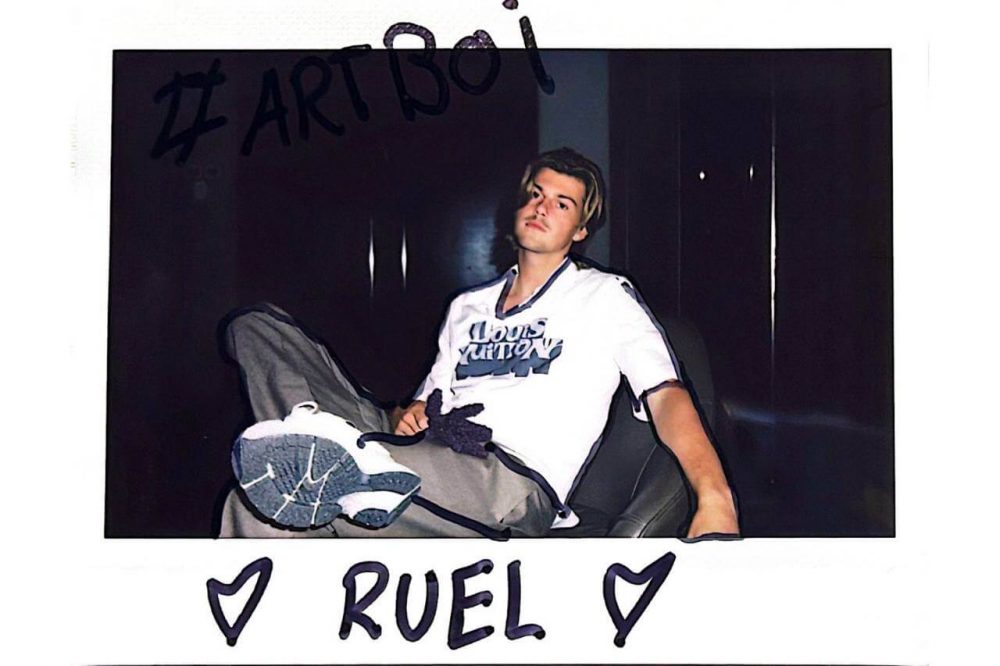
Ruel, wearing a chic white Louis Vuitton shirt and sneakers, radiated quiet tension as he spoke on his new single. As mentioned earlier, ‘It’s not on a particular person,’ he said, sipping a root beer, ‘I just was playing with the feeling of being really stoked that someone’s out of your life.’ For many music fans, it’s intuitive to analyse a singer’s song in an attempt to detect autobiographical elements, like sharp eyes surveying for easter eggs in a bough, but that won’t be a fruitful practice in Ruel’s work; he trafficks in ambiguity. It’s the same in the fast-paced, merrily surreal “You Against Yourself”, released in August this year, a frustrated intervention in self-sabotage. There’s an upward trend in terms of tone in his songs this year – “Let the Grass Grow”, released in April, is a melodic existential crisis; “You Against Yourself” thunders with self-accusations. “Someone Else’s Problem”, however, was ‘super fun to write – it just felt really, y’know, feel-good.’
More than anything, his songs read like monologues, that range from the relieved to the plaintitive, rather than conversations where listeners can comfortably insert themselves as agreeable audiences. And this is the crux of his work, the pièce de résistance: an honesty that can shapeshift from ironic parody to fiercely accusative, beyond smug delight of its own eloquent angst. And yet something insuperably impersonal can be felt behind his fine artistry. His work, by and large, is not feel-good. In the past six years of his career, he has executed an impressive range of emotional registers: disrepair, exhaustion, tired hope; but “Someone Else’s Problem” inserts a tentative optimism, surprising but not unwelcome, perhaps heralding a sunnier mood for future works, or merely a breath of fresh air before diving back down into the depths. Time has improved his experiments in persona, marching from the elusive and soluble to the tangible and insoluble; he’s done haunting and he’s done hazardous; now he’s doing heartbreak.
Unsurprisingly, the fear of vulnerability has little to do with his work. For Ruel, music-making transcends vulnerability – ‘it doesn’t really feel like laying all your emotions or experiences onto strangers, it feels like you’re just portraying a feeling.’ Another sip of root beer. ‘And that’s what excites me about songwriting… to convey all these new feelings and experiences that I’m having and put it in a way people haven’t heard before.’ Originality is hard to find nowadays, at least at first glance, due to the sheer amount of rising artists working within the limits of the medium. And with the disproportionate influence of Tiktok in the music industry, it’s becoming less and less fruitful to expect that all these songs will be well-crafted and smart, without pandering or condescending to their social-media-addled audiences. Any wizened fan would cast a sceptical eye on Ruel’s work, that hovers comfortably around R&B pop – maybe a little too comfortably – and reasonably so. But Ruel’s seemingly impervious to the mounting pressure – to make songs that are catchy and sufficiently airbrushed to loop crazily in tiktok reels. “Someone Else’s Problem” constitutes an invigorating break from the usual breathless pace of today’s pop songs. I’ve always maintained that musicians today are the most subject to the tragedy of artistic commercialisation, with social media determining the benchmark of taste and tightening the cultural loop like a noose around new artists, who will eventually find exploration and experimentation in their fields unprofitable and, later, awfully, inessential. Ruel seems to be keeping that mentality at arm’s length, and making music at his own steady pace, quietly getting better and better.
At his showcase later that evening, he wore a baby blue suit and blue kicks with no shirt, a lá Timothee Chalamet at this year’s Oscars. Exuding calmness and wearing a small but bright smile, his rich and versatile voice overshadows the initial impression of restraint, of reservation. On the rooftop of a posh hotel, surrounded by scores of chatty, crop-topped youths, there was little doubt in the elasticity of his performances – he inhabits whatever stage he’s on with debonair grace. ‘Will you be in my BeReal?’ someone shouted from the front row. ‘I’ll be in your BeReal!’ he yelled back, laughing.
As a general rule of thumb, I don’t expect much from pop music, in terms of genuine artistry or intelligent, thought-provoking lyricism. Ruel made me change my mind. “Someone Else’s Problem”, the song that introduced me to him, rests in the hazy space between endings and beginnings, anticipates loneliness but welcomes uncertainty, and has placed him firmly as one of the most genuinely talented and poised musicians in his generation. ‘Nothing’s getting overblown – no one’s jealous, no one’s crying driving home,’ he warbles at the climax of the song. It’s the same for Ruel, respectively – for his artistry, and hopefully, in his future work.
https://www.youtube.com/watch?v=krFinMewFQk